Study Hall on Thursday, May 21, is cancelled due to plumbing maintenance. Study Hall will resume on Monday, May 25. Thank you for your patience.
All HPL Branches are closed on Friday May 29, for Staff Professional Development. Bookmobile is off the road and Extended Access service is not available. Regular service hours resume on Saturday May 30.
Visit our Virtual Branch at hpl.ca for our online resources and collections.
The accessible washroom at Greensville Branch is not working. We aim to get it fixed quickly.
Renovations are currently underway for the 2nd Floor Central Children's Area. Programs are still being offered as scheduled and there is a temporary pop-up Children’s Area on the northeast side of the 2nd Floor (near the Piano Room), including access to collections and train tables. Construction is expected to be completed by late Spring. Thank you for your patience.
As of Monday, March 2, Sherwood Branch's 2nd Floor is closed due to renovations. Makerspace, Children and Teen's collection are temporarily available on the 1st Floor. All programs will be held in the basement program room. Renovations are expected to be completed in late Spring. Thank you for your patience.
History of City Hall

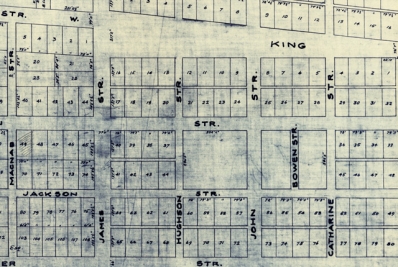
When the Town of Hamilton was incorporated in 1833, one of the first orders of business, after a closely fought election where 3 out of the 4 candidates had no opposition (1), was to find a suitable place for the town board to meet. For the first few years they made do with meeting in local taverns, such as Thomas Wilson's inn on the corner of John and Jackson Streets (2). Mr. Wilson had no objection as he was paid quite well for the privilege of having the governing body of Hamilton in his establishment. The accounts for the town list his payment for the rental of the room as £0/7/6 in 1835 (3).
However, a tavern was not the ideal place to conduct the business of the town and in 1835 Council paid Stephenson Woods £2/15/0 for a plan of an Engine House. In 1836 they paid William Hardy £1/5/0 for drawing the specifications for this plan, contracting Scott & Biggart to build the structure. By November 25, 1835, Council had paid a total of £50/0/0 on account for the construction (4). On August 9, 1836, A. Ross & Co. was paid (£2/0/0) for painting the Engine House (5) and council soon moved in, sharing quarters with the fire department and with the cells in the basement, to conduct the city's business from this more suitable environment.